005
Nháp
My earliest form of keeping a journal must have come from vở nháp—the free-form notebook where I could brainstorm my math exercises and dump my essay outline—back in primary school. The idea was to have a home for your messy, informal notes to keep your main notebooks organized and gradable. Moving on from the nháp tutorial, we would extend its use cases to include things like chat logs with our classmates, paper games like cờ ca-rô (Vietnamese gomoku), or class doodles. I see nháp less as unofficial school notes but more as my first journals, because they showed my thought process, pattern observation, and traces of my friendship.
Since I got into fountain pens during my bachelor’s, my nháp usage has included pen and ink testing, and (so, so many) random scribbles as excuses to use my pens. And finding affordable fountain pen friendly notebooks in Vietnam that satisfy my needs turns out to be a challenge. My ideal notebook is functional:
- The paper shows no feathering and bleedthrough.
- The binding is lay-flat.
- The paper can show ink shading and sheen.
- The paper color leans toward ivory.
- The page designs are subtle and well executed.
- The cover has plain-color options.
- The cover is not bulky.
Searching for the right notebook gets hard when many local brands focus more on how the product looks on the outside rather than what’s inside1—like page designs or how inks behave—in their marketing materials. It gets even harder when brands claim that their notebooks are friendly to fountain pens, only to handle ultra extra fine nibs if threatened by a water gun fully loaded with Baystate Blue.
When choosing paper for fountain pens, absorbency and smoothness are worth noting.
They are mainly affected by the sizing and calendering process in papermaking. Internal sizing adds hydrophobic elements to the paper pulp in the beginning. Surface sizing applies polymeric materials—usually starch—to the paper web as a final seal. Both work differently at different scales to build resistance to moisture and fluids. Calendering evens out the texture of the paper to increase smoothness. Other than that, fiber selection, fiber refining, and coating also contribute to the final result.
For fountain pen users, paper absorbency accounts for the possibility of feathering and bleedthrough, as well as the overall performance of ink. More absorbent paper results in faster dry time, but also increases the likelihood of feathering and bleedthrough. For ink characteristics—like shading and sheen—to develop, the ink also needs to pool on the surface rather than immediately soaking into the paper fibers.
Smoothness is more up to preference. Smoother paper makes your nib glide more easily, while toothier paper offers feedback and more line control. Though functionally, fibers from paper with rough texture can get stuck in your nib tines.
It has been my personal mission to find accessible notebook options in Vietnam to use as my nháp—a functional and beautiful home for my totally meaningful scribbles. Except for MUJI, the other two brands I mention here are Vietnam-based.
Bettino
I came across Bettino in a Vietnamese fountain pen community on Facebook. The fact that their products target fountain pen users got my attention. I’m quite impressed by the high level of sheen the paper is able to show. My preferred product from them is the leather cover insert, as it comes in thinner paper cover options, which I like better for portability. All of their notebook products have very limited cover color options, though.
They also operate internationally as Casta Rustica.
A quick overview of the Refill Notebook Dot Grid in A5:
| Paper weight | 100gsm |
| Paper color | Ivory |
| Paper texture | Toothy |
| Cost per page | Approx. 556₫ (80,000₫ for a 144-page A5 notebook) |
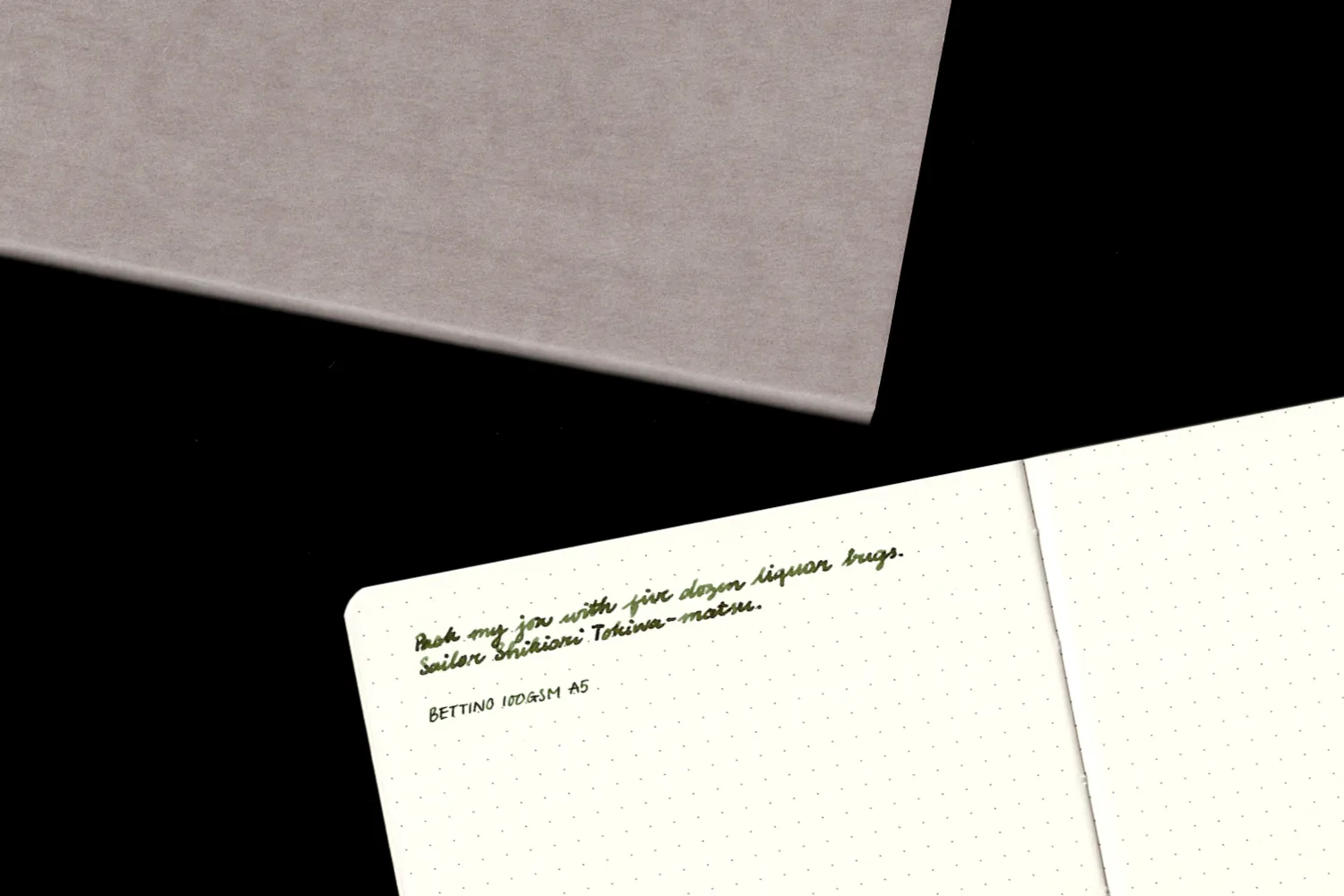
Products I own
- A5 Notebook Plain
Kraft - A5 Refill Notebook Dot Grid
Grey
MUJI
Not all MUJI notebooks are made equal. I only trust notebooks in their High Quality Paper line (and maybe the dot grid variant from other lines—it looks like MUJI uses a different paper stock for them). The paper is smooth, so I guess it’s partially coated to handle fountain pen inks. I’m not a fan of how they pair page ruling (plain, grid, or lined) with cover color, though. Plus, the cover is an oil-stain magnet. But overall, I’m quite fond of the notebooks I got because the paper quality is solid.
MUJI Vietnam website doesn’t always list all available notebook products, or make the High Quality Paper line easily searchable, so I think you’ll have better luck finding one in store.
A quick overview of the High Quality Paper Slim Notebook Grid in A6, except for the cost per page breakdown—I use the A5 price here for ease of comparison:
| Paper weight | Approx. 80gsm |
| Paper color | White |
| Paper texture | Smooth |
| Cost per page | 1,100₫ (176,000₫ for a 160-page A5 notebook) |
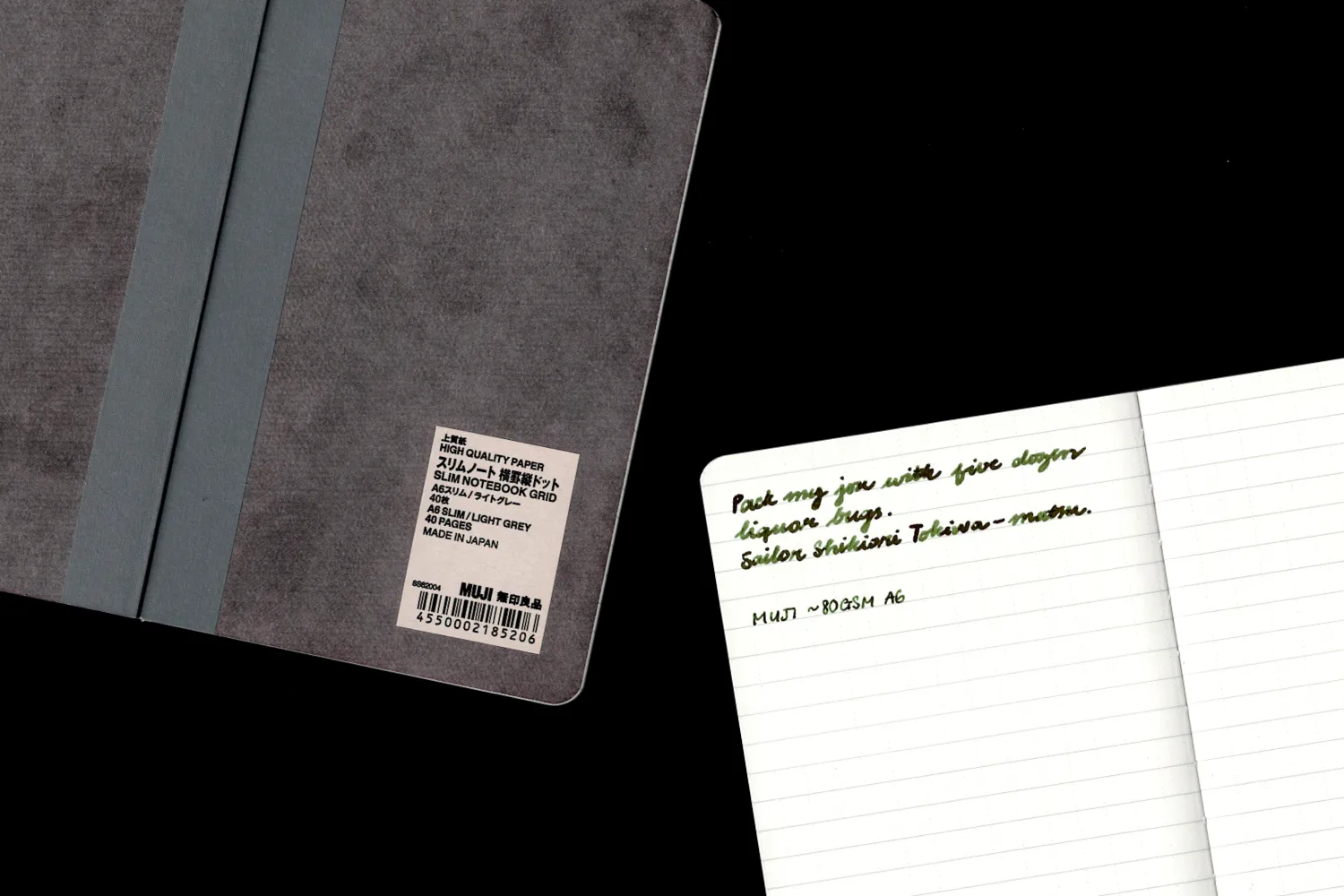
Products I own
- B6 High Quality Paper Slim Notebook Plain
Kraft - A5 High Quality Paper Slim Notebook Plain
Kraft - A6 High Quality Paper Slim Notebook Grid
Grey
Furiin
Furiin’s paper quality seems to vary between batches—the newer ones handle fountain pen inks much better. The paper of the first one I purchased from them has a tiny amount of feathering, which makes my line width half a nib size thicker. The latest ones I got don’t feather or bleed; but ink colors look less saturated and slightly darker on them than on Bettino or MUJI paper. The binding quality can be better. They are still a good option for fountain pens regardless.
They’ve just come back after a long hiatus. I expect the new products are of the same quality because Furiin doesn’t seem to make any major changes, at first glance. But I might have to try another one to confirm.
A quick overview of the Classic Notebook Grid in A5:
| Paper weight | 100gsm |
| Paper color | Ivory |
| Paper texture | Toothy |
| Cost per page | Approx. 994₫ (159,000₫ for a 160-page A5 notebook) |
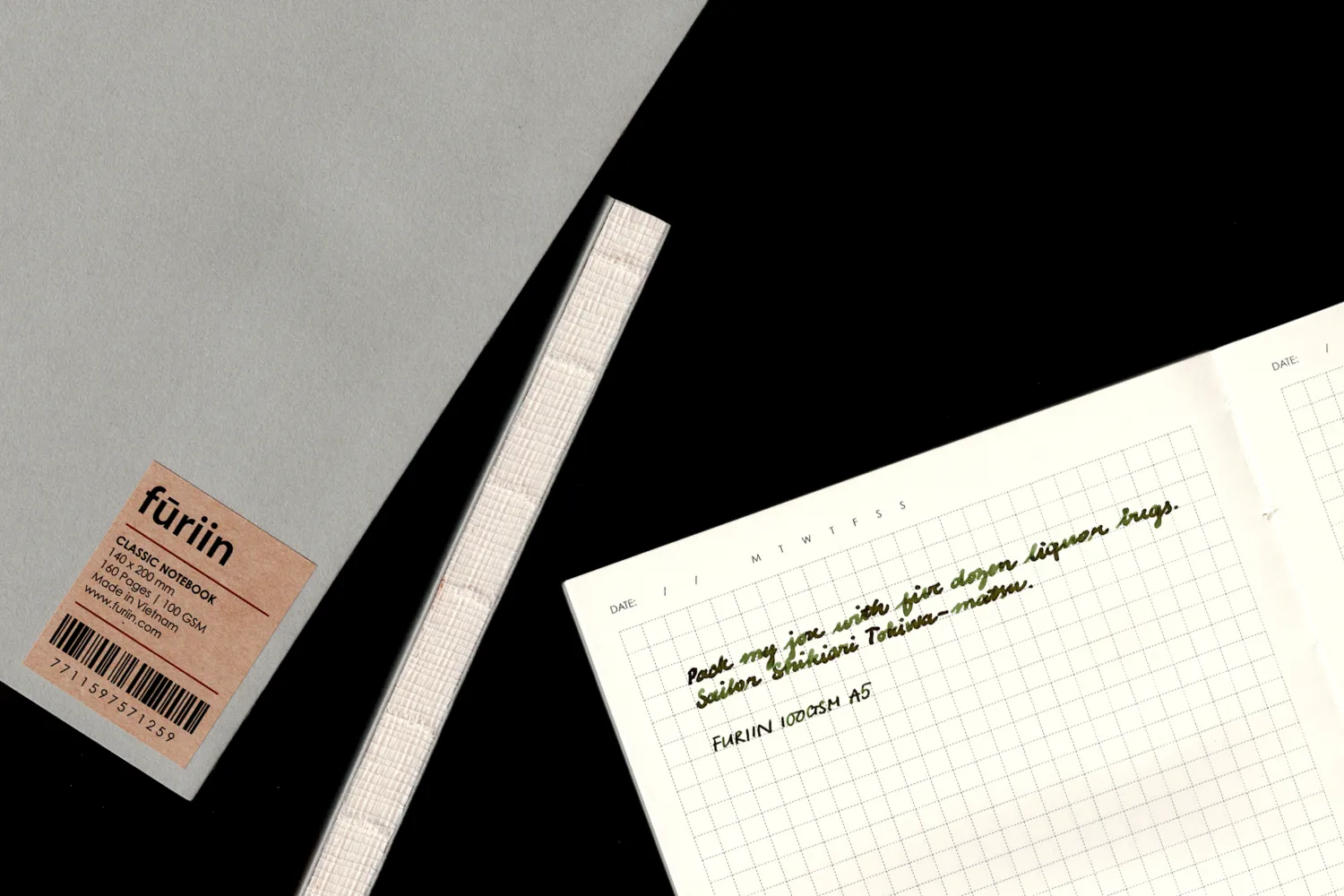
Products I own
- A5 Classic Notebook Plain
Black - A5 Classic Notebook Grid
Grey - A5 Classic Notebook Plain
Kraft
Footnotes
-
The backpack industry here has the same issue. ↩︎
Planted
Tended